Cart0
you have not items in your shopping cart.

Every jeweller has a love collection, and almost all of them are hearts. Wazna’s is mostly names. That is the difference between love as a shape and love as a person, and it is why the collection is the one people buy for someone else.
The collection honours family, motherhood, iconic love stories and dedications to nature. Its designs are deliberately modest, following one family of forms in different styles, and every piece is offered in white, rose or yellow gold, with or without diamonds. Modesty is the design decision: a gift should carry the giver’s meaning, not the jeweller’s signature.
Name pendants. The pieces that define the collection carry a name in Arabic script: Zayed, Mohammed and Khalifa are the three the house makes ready, in silver 925 with white gold plating, set with stones in the colours of the UAE flag beneath an arc of white stones. They hang from a chain or in a car. A full-diamond 18K pendant from the Year of Zayed carries the same idea in gold and can be customised to a preferred name.
The Year of Zayed pieces. The UAE declared 2018 the Year of Zayed, a hundred years after the birth of the country’s founder, and the house marked it with a silver brooch and the pendants above. They remain in the collection because the name did not go out of date.
Mother’s Day pendants. Diamond pendants in 18K rose or yellow gold, made for the one gift in the year that is never bought for oneself.
Hearts, for those who want them. A heart pendant in 18K gold in the three colours, and gold-plated and silver Love pendants with zircon, so the collection has an entry price as well as a top.
Judgment: buy from Love when the gift is about a person and from Strength of Spirit when it is about a quality. A name is the most direct thing jewellery can say, and the Gulf, where names carry lineage as well as identity, is the place it says the most. For a single initial rather than a full name, the letter pendant is the smaller version of the same idea.
The collection is in the shop; a name that is not listed is a short commission through the atelier.

Most bridal jewellery is bought in the wrong order and for the wrong day. It is chosen for the photographs, in the last weeks, as a set, and then it sits in a box for the rest of a marriage because it was never meant for anything else. Wazna’s Majestic Spirit collection is small on purpose and built to be bought in sequence, so that each piece has a life after the wedding.
The house describes it as engagement and wedding jewellery designed to bring joy to the day, built on the brilliance of diamonds in classic settings. It is the tightest of the four collections: full-diamond rings in 18K gold, in white, yellow or rose; two designs of bridal earrings, both full diamond in 18K, the chandelier pair falling in tiers of pave drops; and a full-diamond pave chain-link choker, again in the three golds. Nothing in it is for one occasion only.
The ring first, and alone. It is the only piece worn every day for decades, so it decides the gold colour for everything that follows. Before choosing it, read the stone the way a jeweller does; our guide to the 4Cs is written for exactly this purchase.
The earrings second, and in the same gold. Bridal earrings are the piece most likely to be worn again, at every wedding the couple attends afterwards, so weight matters more than size: a chandelier that is light on the ear gets worn; one that is not gets admired in the box.
The choker last, and only if the neckline calls for it. A pave chain-link choker is the statement piece of the three and the one that most needs the dress in front of it before the decision is made.
Matching everything. A set where ring, earrings and choker share one design reads as a costume. A set where they share one gold and one level of finish reads as a woman who chose. The collection was built for the second reading.
Majestic Spirit is in the shop. Engagement rings are also commissioned through the atelier, where the stone, the setting and the band are chosen one at a time.

Jewellers reach for flowers, stars and hearts because nobody has to explain them. Wazna’s biggest collection is built on a screw, which everybody has to explain, and that is the point. A motif that needs a sentence is a motif that starts a conversation, and the sentence is the house’s thesis: strength and patience are what hold a life together, and they are worth wearing.
The house describes the screw as a symbol of vigour and patience, and ties it to a belief that positivity is what activates the spirit and connects it to the divine within. On the pieces it appears as a small screw head, usually in white gold, set into a field of pave diamonds on rose, yellow or white 18K gold. On a ring it sits where a stone would; on a bangle it repeats; on earrings it is the whole design. It reads as industrial from a distance and as jewellery up close, which is the trick.
Strength of Spirit is the largest of the four collections and the one with the widest range of materials, so it is where most first purchases happen. At the top are the full-diamond pieces in 18K gold: rings, pendants in several sizes, earrings, bangles and a long chain necklace, each offered in rose, white or yellow. One ring carries a five-carat round brilliant graded VS1, on a fluted band, for those who want the argument made loudly. In the middle are the leather pieces: bracelets and rings in black or green leather closed with 18K gold. At the entry level are silver rings and bangles with the same motif. The falcon pendants, in three sizes and three golds with a small stone hanging from the beak, are the collection’s other emblem, and the one that sits as well on a man as on a woman.
Judgment, not doctrine. Start with the piece you will wear most days, which for most women is a pendant or a bangle rather than a ring. Choose one gold colour and stay with it; the screw head is white on every colour, and a mixed set loses that contrast. Add the second piece in the same scale, not a bigger one. The collection was designed to be worn in multiples, but multiples of the same voice.
The full range is in the shop. If the motif should carry a stone, an engraving or a size that is not listed, the atelier makes it.

A diamond is the hardest natural material there is, and that fact ruins more jewellery than it protects. Owners treat the stone as indestructible and the setting as part of the stone. The stone survives; the setting does not. Here is what actually damages fine jewellery, and what to do about it, drawn from the Gemological Institute of America’s care guidance.
Diamond sits at 10 on the Mohs scale and, in GIA’s words, only a diamond can scratch a diamond. Two consequences follow. First, a diamond stored loose with other pieces will scratch everything it touches, including your gold. Second, hardness is not toughness: any stone, including a diamond, will break if it is hit hard enough in the right place, and pointed shapes are the most exposed at their corners. A diamond that has worked loose in its setting will also, over time, wear through the prong that holds it.
18K gold is 75 per cent gold and 25 per cent alloy, and it is the alloy that reacts. Chlorine bleach can pit or damage gold alloys, which is why the pool and the cleaning cupboard are the two places fine jewellery should never go. Hairspray, lotion and perfume leave a film that dulls both metal and stone; in a region where fragrance is applied generously, the rule is perfume first, jewellery last. White gold has one more habit: its rhodium plating wears, and the piece is re-plated to bring the white back.
Warm water, mild dish soap and a soft brush, then a rinse in a glass of water rather than under a running tap, so a loosened stone lands in the glass and not the drain. Dry with a lint-free cloth. Avoid powdered abrasive cleansers, and avoid home ultrasonic and steam cleaners, which can loosen stones in their settings; those machines belong with a jeweller who checks the piece before and after.
GIA’s advice is to have jewellery checked every six months and cleaned frequently. For a piece worn daily, a diamond ring above all, that check is the difference between tightening a prong and replacing a stone. Store each piece separately, in its box or a padded case, never loose in a drawer.
Questions about a Wazna piece go to the atelier in Barsha South: contact us and we will tell you what it needs.

The most valuable piece in a woman’s jewellery box is rarely the most expensive one. It is the one with a letter on it, because a letter is a decision someone made about her. Every other piece could belong to anyone. This one could not.
A letter is bespoke at its smallest scale. There is no consultation and no sketch, and yet the piece is built around one person. It carries an initial, a child’s name, a mother’s, a word that means something only to two people. In the Gulf, where names carry family and lineage as well as identity, the letter is a heavier thing than it looks.
The house makes letter pendants in 18K gold set with diamonds, in rose, white or yellow gold, and every letter is available. On the Arabic side of the collection the same idea runs on bracelets: a diamond letter in 18K gold, again in all letters. The letter can stand alone on its chain or sit beside a second charm, as it does on the piece pictured, where a diamond letter shares the chain with a hamsa charm.
Three questions decide it. First, whose letter: hers, or the name she would want closest to her? A mother often wants a child’s initial more than her own. Second, which gold: rose reads as personal, white lets the diamonds speak, yellow is the classic. If in doubt, match what she already wears every day. Third, script: an Arabic letter and a Latin one carry the same name in two different voices, and the choice says which voice you mean.
If the letter you want is a word, a date or a symbol rather than a single character, that is where the letter pendant ends and the bespoke atelier begins.

Western jewellery was designed for a neckline. The Arab gown does not always have one to offer, and the abaya has none at all. That is the gap Wazna’s Rank collection was built for: it moves the jewellery from the neck to the two places an Arab silhouette actually shows, the shoulder and the waist.
The house describes the collection as inspired by Arab culture and made for women who lead, fusing tradition and modernity. In the hand, a Rank is a run of hinged, angular gold segments that step and fold like the chevrons on an insignia, with the inner faces set in pave diamonds. Worn on the shoulder it reads as a mark of standing; the name is not decorative. The matching Belt takes the same architecture around the waist of a gown or a jalabiya, where a fabric sash would normally sit.
Unusually for a fine jeweller, Wazna offers the collection at three levels of material, so the design is not reserved for one price. The Diamond Rank and Diamond Belt are 18K gold, in rose, white or yellow, set with diamonds. The Gold-Plated Rank and Gold-Plated Belt use zircon stones on plated metal. The Silver Rank and Silver Belt use zircon on silver. A pair of Diamond Earrings in 18K gold, in the same three colours, completes the set. The shape is the same across all three; what changes is what it is made of.
Three rules, all judgment rather than doctrine. One shoulder, not two, unless the occasion is formal enough for symmetry. The Belt on a plain gown; the pattern of the piece is the pattern of the outfit, and a printed fabric fights it. And when a Rank is on the shoulder, keep the neck bare; the whole point is to move the eye, not to crowd it.
A Rank also answers a practical question Emirati women are asked more than most: what jewellery works with an abaya. Very little that hangs from the neck does. Something that sits on the shoulder does.
The collection is in the shop, and a Rank can be commissioned in a different scale or stone through the atelier.
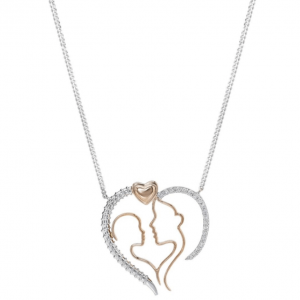 Diamond Pendant 18K Rose Gold (Mother's Day) 8,004 AED
 Diamond Ring 18K Gold 11,674 AED
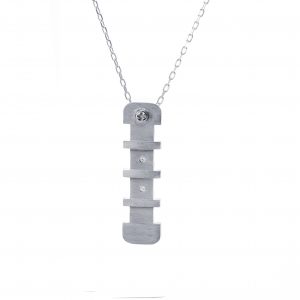 Silver Pendant 10mm 2,400 AED