Cart0
you have not items in your shopping cart.

The colour of gold is the first decision in any piece and the one most people make in the last thirty seconds. It deserves the first thirty minutes. The three colours are not three metals; they are one metal with three companions, and the companion changes how the piece looks, wears and ages.
Pure gold is 24 carat. 18 carat gold, the standard Wazna works in, is 75 per cent gold and 25 per cent other metals, most often copper or silver. That quarter is not a compromise. Pure gold is too soft for a ring worn daily; the alloy gives it the hardness to hold diamonds in place for decades. It is also where the colour comes from.
Yellow gold keeps the natural colour of the metal, with the silver and copper in the alloy balanced so that neither pulls the tone.
Rose gold gets its soft pink from copper. More copper, warmer pink. Rose gold reads as the most personal of the three, and on warm skin tones it reads as an extension of the skin rather than an object on it.
White gold is made by alloying gold with white metals such as palladium or silver, and it is usually plated with rhodium to give a harder surface and a brighter shine. That plating is why a white gold ring looks whiter in the shop than after five years of wear, and why white gold pieces are periodically re-plated. It is not a flaw; it is how the material works, and any honest jeweller will tell you so before you buy.
Choose by three questions, in this order. First, what do you already wear every day? A new piece that fights the colour of a watch or a wedding band will be worn less. Second, how visible do you want the diamonds to be? White gold disappears behind white diamonds so the stones do the talking; yellow and rose gold frame them. Third, how much maintenance will you accept? Yellow and rose gold age by softening; white gold ages by asking for a visit.
At Wazna, the Love collection and the letter pendants are made in all three colours, and every bespoke piece is offered in rose, white or yellow. The house’s advice is the same in every case: decide the colour first, then design the piece around it, never the reverse. If you want help deciding, the atelier starts there.

The UAE is one of the easiest places in the world to buy a diamond and one of the easiest places to buy the wrong one. The choice is wide, the prices are competitive, and the vocabulary is designed to sound reassuring. Here is what the words mean, and what to ask before you pay.
Every serious jeweller grades diamonds on the four scales set by the Gemological Institute of America (GIA), the 4Cs: colour, clarity, cut and carat weight.
Colour. GIA grades colour on a scale from D to Z. D is colourless; Z shows light yellow, brown or grey. The letters were chosen to start at D so that no one could confuse the scale with older systems. Grading is done under controlled light against a set of master stones, which is why a grade from a laboratory means more than a grade from a shop counter.
Clarity. Eleven grades, all judged under 10x magnification: Flawless, Internally Flawless, VVS1 and VVS2, VS1 and VS2, SI1 and SI2, and I1 to I3. In GIA’s language, VS stones have inclusions “observed with effort” and “minor”; SI inclusions are “noticeable”; I-grade inclusions are “obvious” and may affect brilliance and durability. For most pieces worn daily, the difference between VVS and VS is invisible to the eye and visible on the invoice.
Cut. GIA’s cut grade runs from Excellent to Poor, and it is given only to round brilliant diamonds, because they are the only shape with standardised facets. Every other shape is a “fancy” shape and carries no cut grade. Cut is the measure that decides how much light a stone returns, and it is the one most often left out of the conversation.
Carat. A metric carat is 200 milligrams, divided into 100 points. Carat is weight, not size; two stones of the same weight can look different depending on cut and proportion.
The UAE has charged VAT of 5 per cent since January 2018, and it applies to jewellery. If you are visiting rather than resident, the government’s tourist refund scheme returns most of it: you must be 18 or over, buy from a retailer registered in the scheme, spend at least AED 250 in the transaction, validate the purchase at the airport within 90 days, and claim within one year. The refund is 85 per cent of the VAT paid, after a fee of AED 4.80 per tax-free tag.
Which laboratory graded this stone, and can I see the report? Is the cut grade on the report, and if the stone is not a round brilliant, why not? What is the metal, and what carat of gold? Is the price quoted with VAT included? Will the invoice carry the stone’s grades and weight exactly as the report states them?
A jeweller who answers all five without hesitation is worth buying from. At Wazna every diamond piece is made in Dubai in 18K gold, and every commission through the bespoke atelier begins with those five answers rather than ending with them.

Most jewellery houses sell objects. Wazna sells an argument: that strength and elegance are the same quality in a woman, seen from two sides. Every collection the house has produced in Dubai is a variation on that one idea, in diamonds and 18K gold. Here is what each of the four says, and how to read them together.
The largest of the four collections takes its form from a screw. The house describes it as a symbol of vigour and patience: the small, plain object that holds structures together. On the pieces, the screw head sits as a motif on rings, pendants, bangles and earrings, often set in pave diamonds against yellow, white or rose gold. It is the collection most of the house’s pieces belong to, and it carries the house’s stated belief that positivity is what activates the spirit and gives a life purpose.
This is the bridal line: engagement and wedding jewellery built to carry the day. The designs lean on the brilliance of diamonds in classic settings, made to be photographed on one date and worn for decades after it. Where Strength of Spirit is a statement, Majestic Spirit is a promise.
Rank is the collection that could only have come from the Gulf. It was designed for Arab women who lead, and its name is the word itself: rank, standing, position. The pieces fuse tradition and modernity and are made to be worn where Western jewellery rarely goes: across the shoulders of a gown, or around the waist as a belt. On an abaya or an evening dress the effect is architectural rather than decorative. It is the most Emirati thing the house makes.
The Love collection honours family, motherhood, iconic love stories and dedications to nature. Its designs are deliberately modest, following one family of forms in different styles, and every piece is offered in white, rose or yellow gold, with or without diamonds. It is the collection most often given rather than bought for oneself.
Strength of Spirit is the everyday statement. Majestic Spirit is the vow. Rank is the occasion. Love is the gift. A woman can wear the four across a life without any of them contradicting the others, because they are built on the same premise.
The house also makes pieces outside the four collections, and takes commissions for pieces that exist only once. If the collection language speaks to you but you want it in your own accent, the bespoke atelier is where that conversation starts.
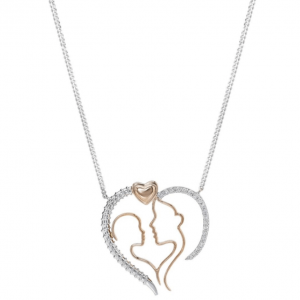 Diamond Pendant 18K Rose Gold (Mother's Day) 8,004 AED
 Diamond Ring 18K Gold 11,674 AED
 Silver Pendant 10mm 2,400 AED